
Attendance · Schools and trusts
Know who needs attendance support — and what to do next.
Attendance Officer AI reads your attendance data each night, identifies pupils and groups that need attention, and shows staff the appropriate next step from your own attendance policy and DfE guidance.

Act before absence becomes established.
Attendance work starts before a pupil becomes persistently absent. Attendance Officer AI looks for changes in the register: a day of the week that keeps being missed, clusters of lateness, runs of short absences, a pattern that changes, and pupils moving towards persistent absence.
It turns that into a short, prioritised view for the people responsible for attendance. Staff can see who needs attention, what the school already knows and what should happen next.
Class teachers
A short list of pupils who need attention today.
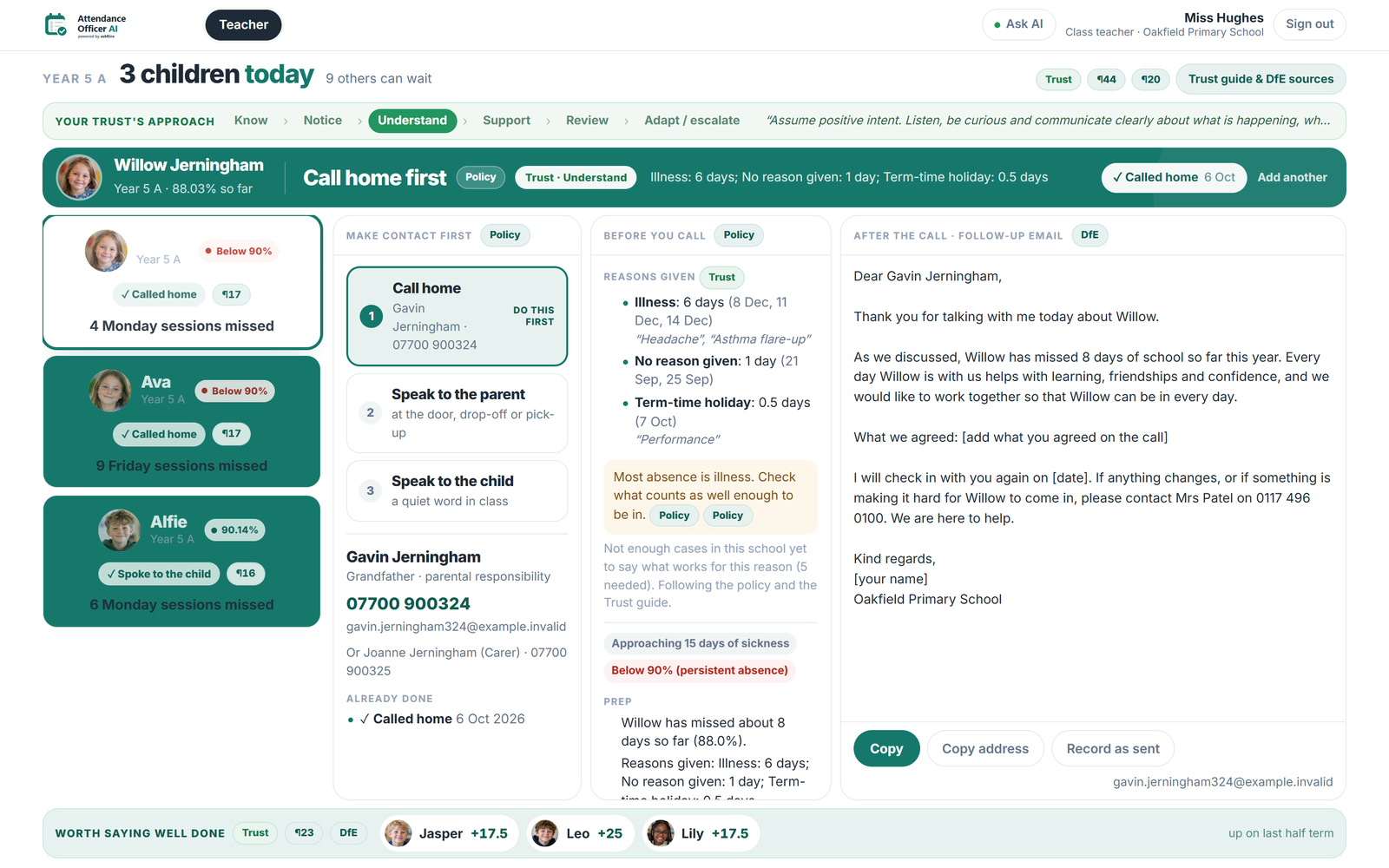
Teachers do not need another whole-school attendance dashboard. They see the pupils in their own class who need a conversation or follow-up, with the recent attendance pattern, parent or carer contact details and what has already been recorded. The suggested action is simple: speak to the pupil, speak to the family, or call home, with a follow-up email ready to edit afterwards.
Attendance and pastoral teams
See the full attendance history before you act.
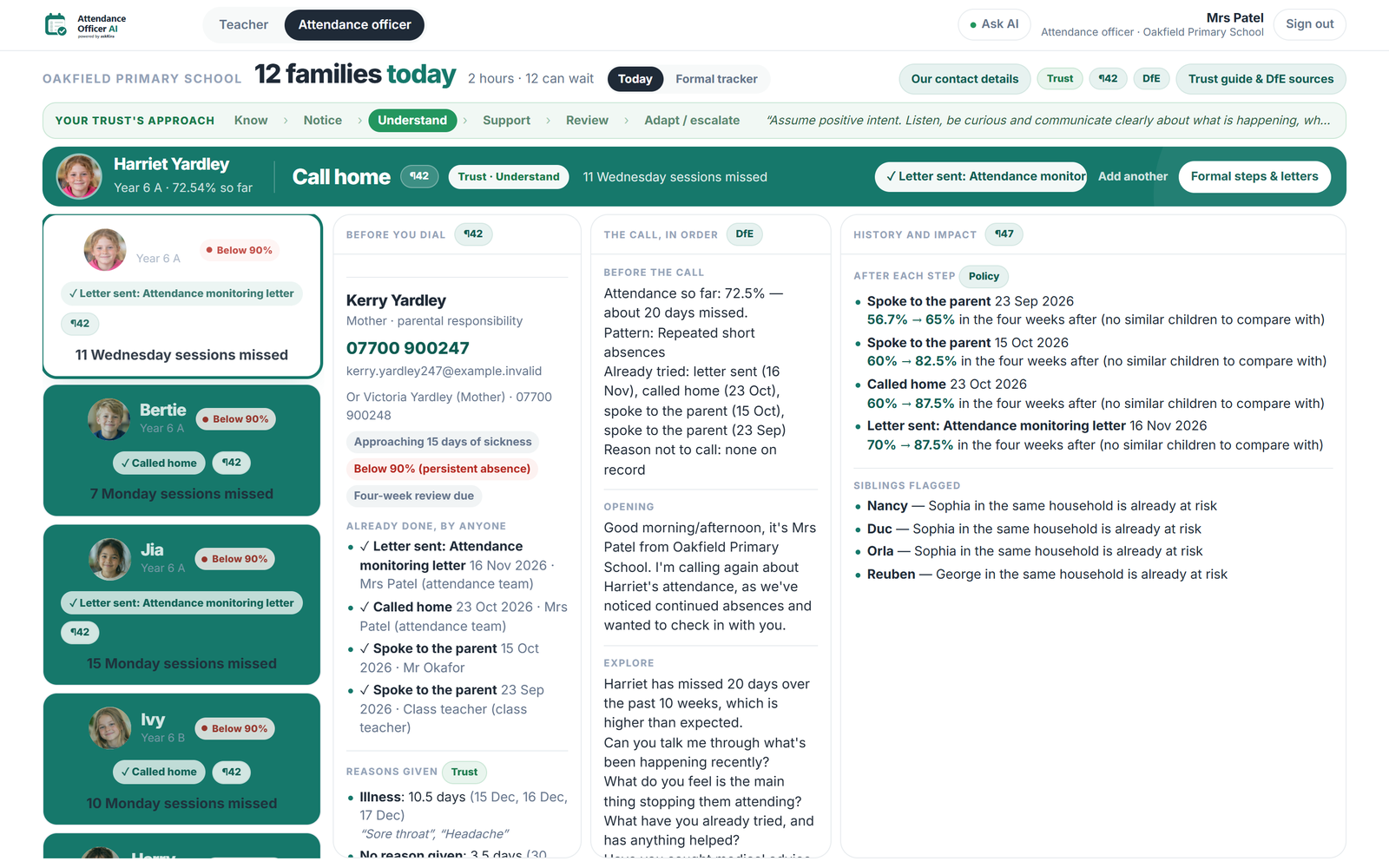
Attendance teams can see the pupil’s attendance pattern, recorded reasons for absence, previous conversations, support already offered, EHAP targets and any reviews that are due. Staff can continue the work already underway rather than starting the same conversation again. Where a formal step is being considered, the relevant school policy and DfE guidance sit alongside the record.
Headteachers and SLT
See where attendance needs attention.
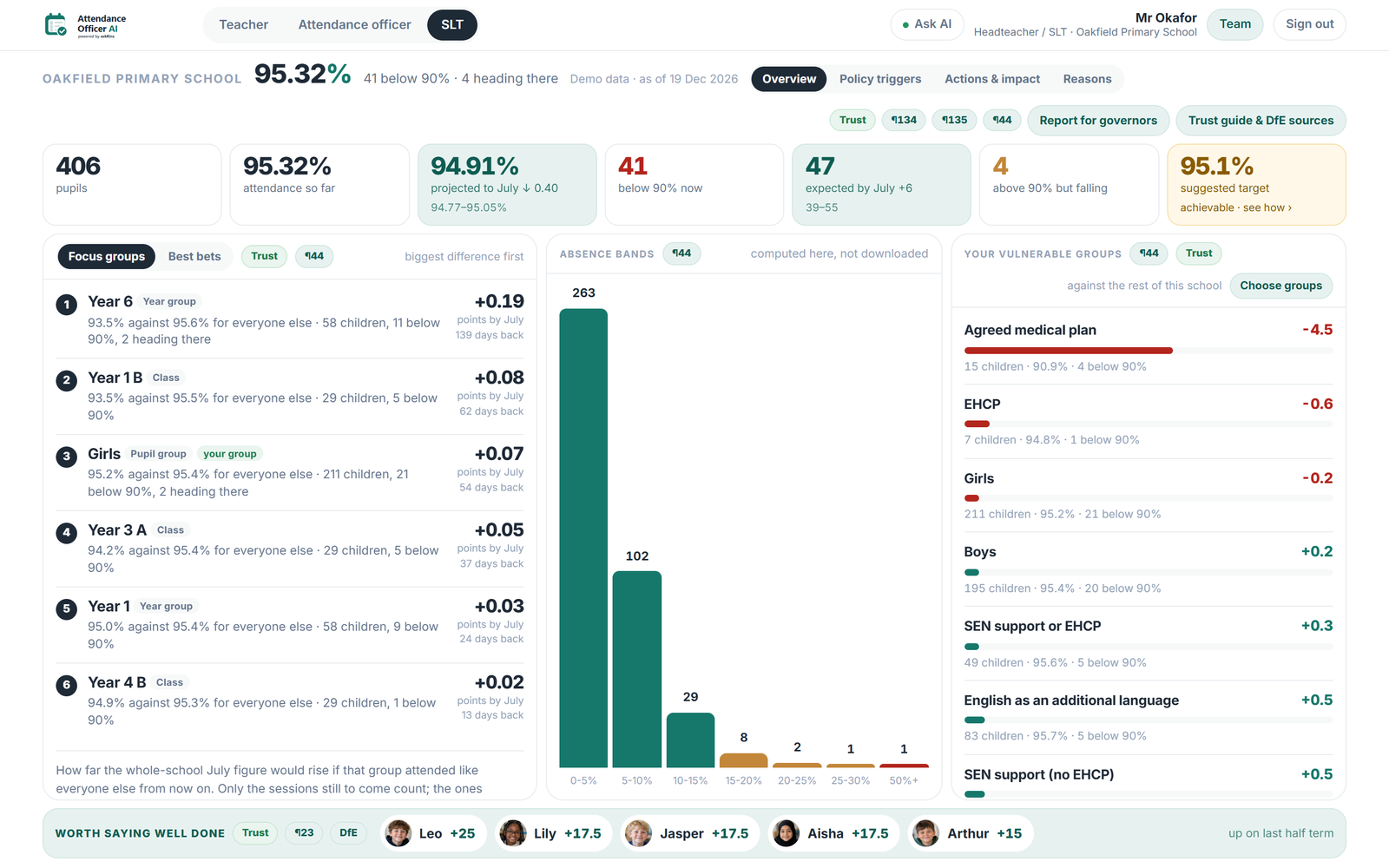
Leaders can see attendance across the school, including pupils approaching persistent absence, pupils already persistently or severely absent, and patterns by year group, class and the pupil groups the school chooses to follow. The aim is not simply to report a percentage. It is to show where attendance is changing, which pupils and groups need support, and where leadership attention could make the greatest difference.
The DfE defines persistent absence as missing 10% or more of possible sessions, and severe absence as missing 50% or more. Attendance Officer AI also shows the pupils approaching persistent absence, so support can begin earlier.
Your attendance policy
Apply your policy consistently.
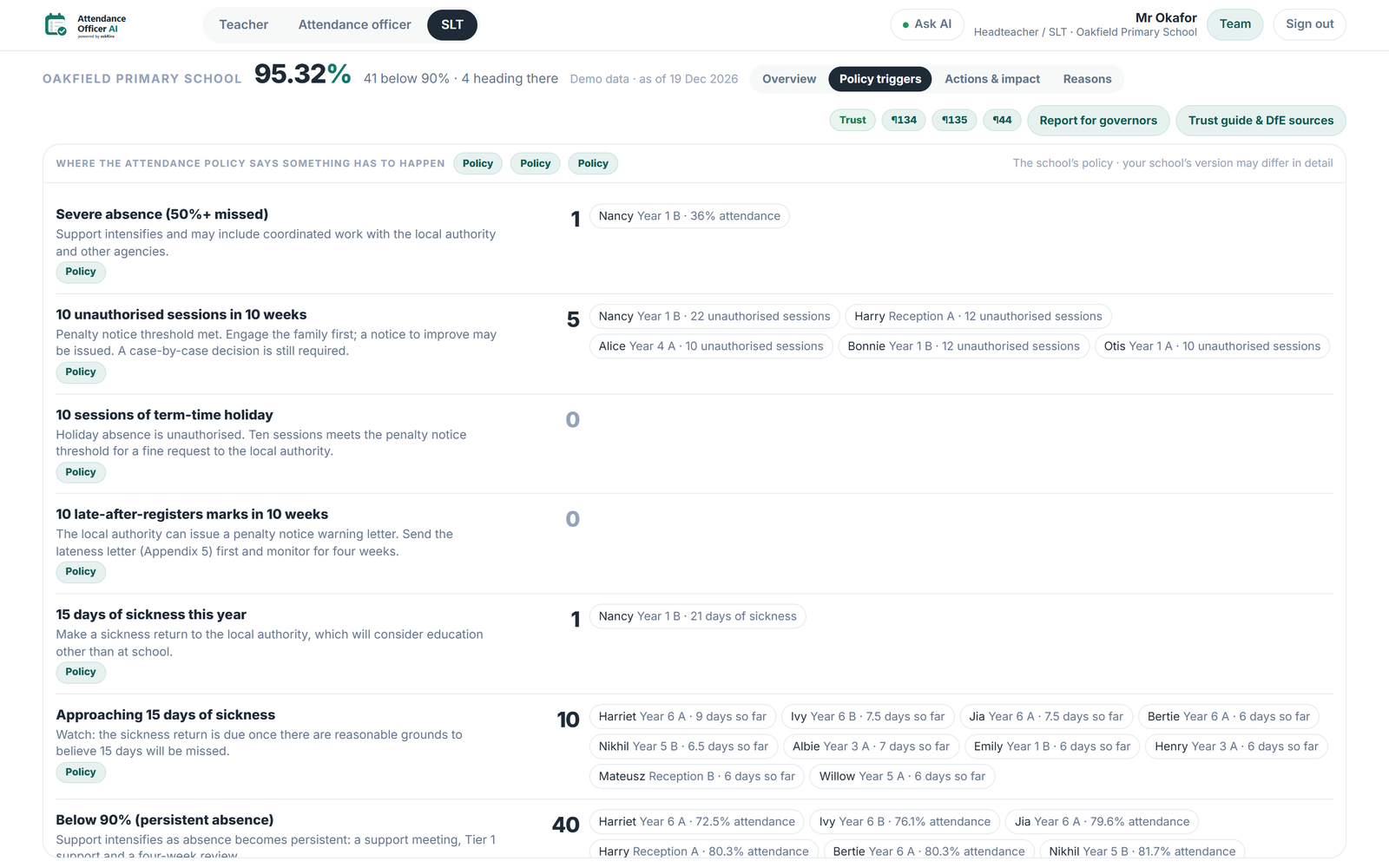
Every school has points at which its attendance policy expects something to happen. Attendance Officer AI checks the register against those points each night and shows staff which pupils may now need action: monitoring, a conversation with the family, a review, additional support or consideration of a formal attendance process. The relevant policy wording is shown alongside, so staff can see why the action has been raised.
A trigger is a prompt for professional judgement, not an automated decision.
Actions and impact
See what happened after the action.
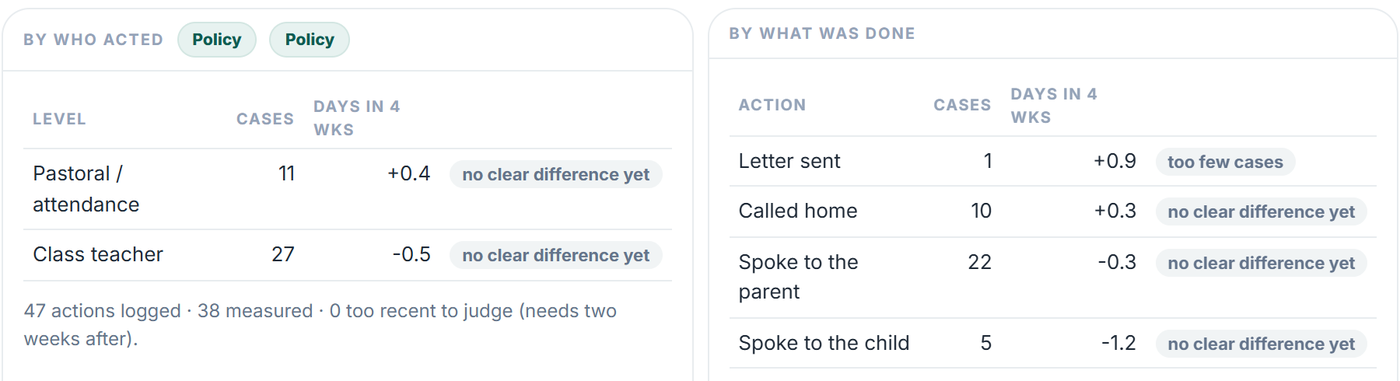
Calls, meetings, letters, support plans and reviews are logged against the attendance record. Attendance Officer AI then shows what happened to attendance afterwards, so leaders can see which actions are being used, where attendance improved and where a different approach may be needed.
Attendance changing after an action does not show the action caused it. Where there is enough data, the system compares outcomes with similar pupils at the same school who did not have the same action recorded, and it reports nothing until there are at least five cases.
Trust leaders
See attendance across every school.
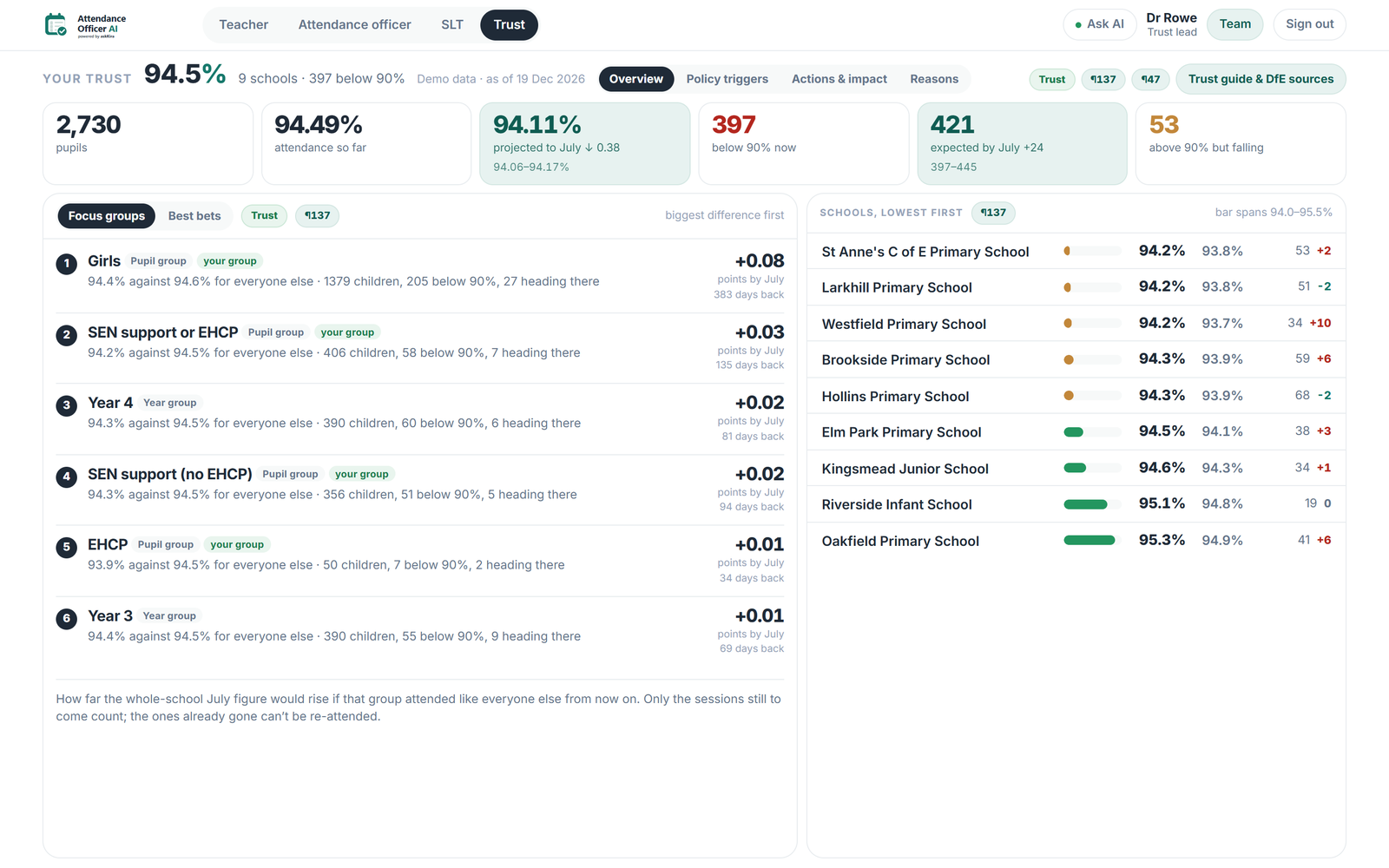
Trust leaders see attendance, persistent absence, key pupil groups and emerging patterns across their schools. They can compare where attendance is improving, where additional support may be needed and how different approaches are being used. The trust view uses aggregated figures and does not display individual pupils.
DfE statutory guidance · How it works
Put the attendance guidance into everyday practice.
The DfE’s Working together to improve school attendance asks schools to identify attendance problems early, understand the reasons for absence and work with pupils and families to remove barriers. Attendance Officer AI helps staff follow that process consistently, from the register to the next action.
- 01
Expect
Keep attendance visible across the school and make expectations clear.
Attendance Officer AIReadRead approved attendance data from the MIS overnight. - 02
Monitor
Use the register to identify pupils and groups whose attendance is changing or needs support.
Attendance Officer AIIdentifyFind pupils and groups whose attendance pattern needs attention. - 03
Listen and understand
Bring together the attendance pattern, reasons already given and previous contact, so staff go into the conversation informed.
Attendance Officer AIUnderstandBring together the attendance history, recorded reasons and previous contact. - 04
Facilitate support
Record agreed actions, support and review dates, so everyone knows what is being done.
Attendance Officer AIReviewKeep actions, support and review dates together. - 05
Formalise support
Show when the school’s policy or the guidance indicates that a formal attendance plan, meeting or review should be considered.
Attendance Officer AIActShow the appropriate next step from the school’s policy and DfE guidance. - 06
Enforce
Where support has not worked, is not appropriate or has not been engaged with, set out the relevant policy and guidance for an authorised member of staff to consider.
Attendance Officer AILearnShow what happened to attendance after action was taken, so staff can see whether support has worked.
Attendance Officer AI provides the evidence and the guidance. Staff make the decision.
Communicating with families
Clear, factual and focused on support.
DfE guidance asks schools to communicate clearly with parents and carers about attendance, and to work with families to understand the barriers behind absence. Attendance Officer AI helps staff prepare those conversations using the information the school already holds.
When something needs to be written down, drafts are practical and based on the record: the attendance concern, what has already happened and what happens next. Absence is described in days missed rather than as a percentage. Nothing is sent automatically, and nothing is drafted where a bereavement, long-term illness or safeguarding record is on file.
Guidance
Built around the rules schools already work to.
Attendance Officer AI is being developed with schools and a multi-academy trust around three things: the trust’s attendance approach, each school’s own attendance policy and the DfE’s statutory guidance, Working together to improve school attendance. Where it suggests an action based on guidance or policy, staff can see the source behind it. The guidance is quoted from the published documents and re-checked against them each time the product is updated, rather than copied in once and left.
Who it is for
The same attendance data. The right view for each role.
Class teachers
A short list of pupils in their class who need a conversation or follow-up.
Attendance officers and pastoral leads
The caseload, attendance history, previous contact, support, formal steps and review dates.
Headteachers and SLT
School-wide attendance, persistent and severe absence, pupil groups, policy triggers and priorities.
Trust leaders
Attendance across schools, key groups, trends and the approaches being used, without individual pupil names.

Read the register. Do not create another copy of it.
- Read-only, through Wonde. The register is read from your MIS to build the views, then discarded. It is not kept as a second attendance database.
- Role-based access. Teachers see their own classes, school staff only the pupils they are authorised to see, and the trust view uses aggregated figures rather than pupil names. Access is by invitation.
- Contact details stay out of the AI. The language model never receives parents’ or carers’ contact details, and the action log records a scrambled code rather than a name.
- Hosted in the UK on AWS London. Your data is never used to train AI models.
Pricing
Priced for your trust.
Your trust
Priced per trust
Set up around your schools, your MIS, your trust’s attendance approach and each school’s policy
- Connected to your MIS through Wonde, read-only
- Your trust attendance guide and school policies built in
- Start with one or two schools, then extend across the trust
Attendance Officer AI is currently in pilot. To talk about your trust, book a demo.
Turn attendance data
into clear action.
Give teachers, attendance teams and leaders the information they need to identify concerns early, work with families and follow your attendance policy consistently.
Book a demo